
What Are Robotic Palletizers?
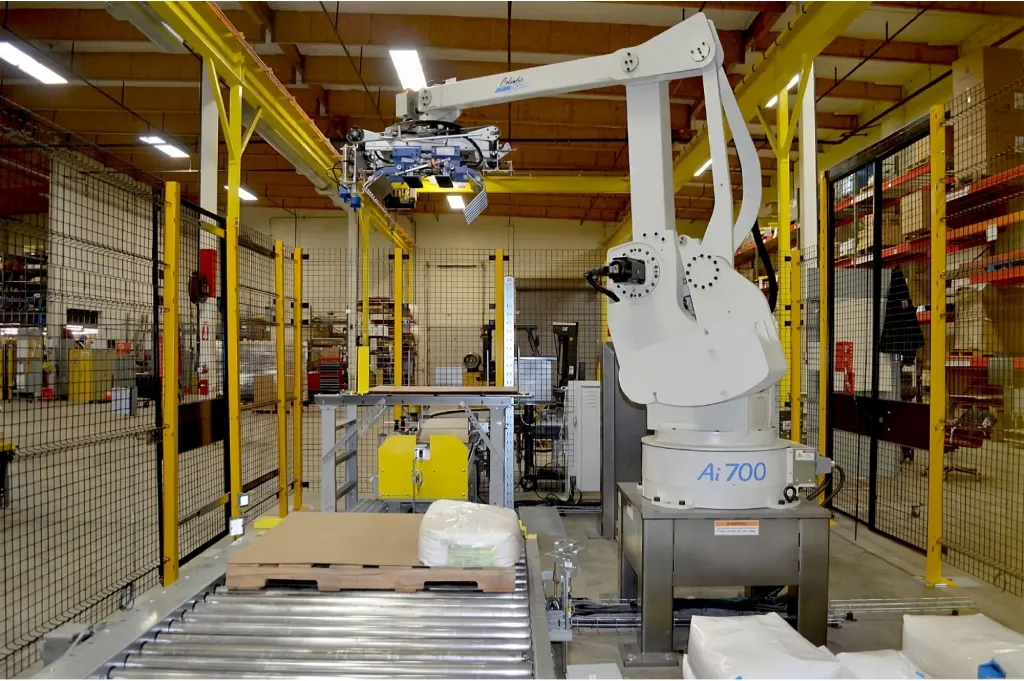
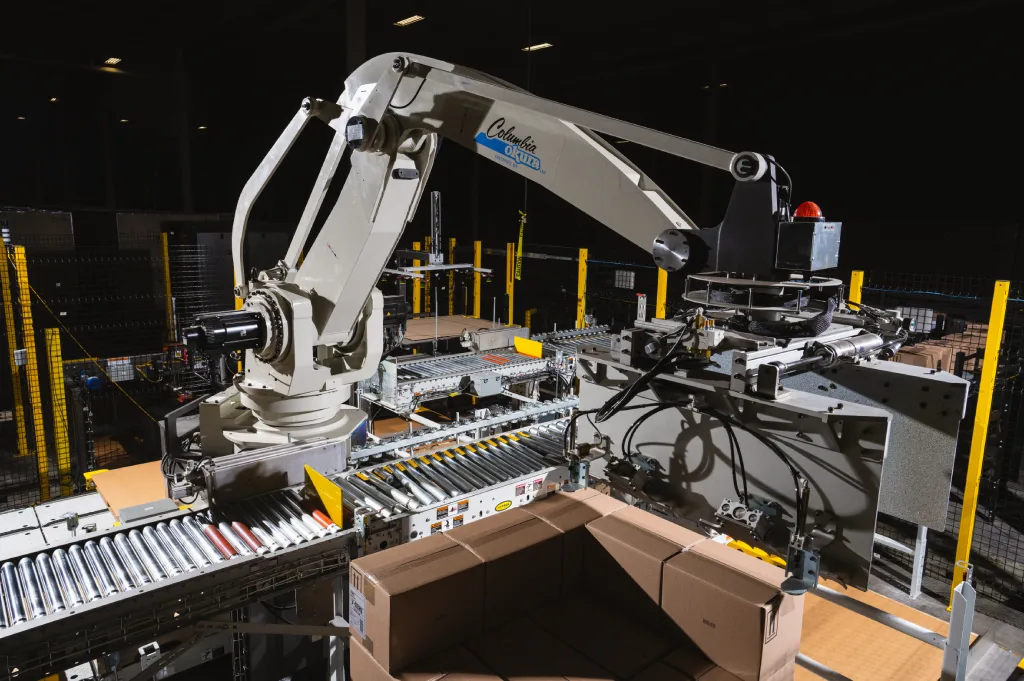
A robotic palletizer help stack packaged goods, including cases, bags, bundles, pails and more, onto pallets in predefined patterns. Present-day systems mix industrial robots or cobots, end-of-arm tooling, pallet stations, and software that handle patterns, layers, and changeovers.
How Do Robotic Palletizers Work?
At a higher level, a robot palletizer machine obtains products from upstream conveyors and recognizes orientation and placement. To prepare stable and consistent loads, it executes a properly programmed pick-and-place sequence. Tooling and sensors ensure grip and placement; software handles recipes, interlayer sheets, and pattern optimization. In the stacking of packaged goods, including cases, bags, bundles, pails and more, onto pallets in predefined medium to high-volume packing. A programmable palletizer reduces manual handling while enhancing throughput and repeatability.
Types of Robotic Palletizers:
Single-line palletizers: The working mechanism relies on a single robot dedicated to a single production line, making them ideal for consistent, high-volume SKUs.
Multi-line or rail-mounted systems: one robot carries multiple lines by utilizing scheduling logic to balance the workflow.
Collaborative pallets (cobots): prepared for slower rates and close human interaction, prioritizing space efficiency and ease of deployment.
Hybrid systems with consolidated packing: Pair case packing and palletizing for compact end-of-line cells.
Throughout these formats, forefront robotic palletizing solutions emphasize modular hardware, adaptable software, and EOAT (end-of-arm tooling) alternatives which fit case, bag or bundle applications.
Key features of a Robotic Palletizer Machine
Adaptable EOAT: Vacuum, clamp, fork, and bag grippers to manage various packaging types.
Recipe-led patterns: Rapid changeovers, mixed SKU potential, layer-sheet positioning.
Throughput and uptime controls: Infeed metering, slip-sheet dispensers, and automatic pallet handling.
Safety and compliance: Integrated guarding, scanners, and control reliability matched present standards.
Analytics and HMI: Integrated dashboards, alarm systems, and maintenance analytics enable better monitoring and decision-making to enhance performance and sustain OEE (Overall Equipment Effectiveness).
How are Robotic Palletizers used in the Food and Beverage Industry?
The food and beverage sector relies on palletizers to efficiently handle diverse range of packaging formats, including trays, cases, and shrink-wrapped bundles, while ensuring compliance with hygiene and uptime requirements. This enhances line performance and productivity, resulting in fewer damaged products and more ergonomic workflows. Many adopters also notice significant cost savings and increased efficiency in their warehouses and distribution centers.
What are the advantages of using a Robotic Palletizer?
Throughput and Consistency: Accurate, repeatable stacking at sustained prices.
Workforce safety and ergonomics: Automation minimizes repetitive lifting and reduces the risk of injury.
Adaptability: Seamlessly handles rapid recipe changes, enabling smooth SKU expansion and meeting seasonal production demands.
Space efficiency: Utilizes compact cells instead of bulky traditional machines, with flexible options for multi-line configurations.
Cost and ROI: Minimized rework and damage; many deployments recover their investment within the usual payback windows prevalent throughout the industry.
Why choose Columbia Machine India Palletizers?
Columbia Machine India offers advanced robotic palletizing solutions optimized for Indian production environments, supported by Columbia’s international portfolio of proven technologies and services. Customers generally benefit from:
Application Range: Cases, bags, pails, specialty packs.
Our team provides comprehensive lifecycle support, encompassing layout design, installation, training, and ongoing service, all underpinned by global engineering standards.
Integration of readiness: Compatible with upstream packers, wrappers and conveyors, authorizing phased automation.
Regulatory and Safety Standards for Robotic Palletizers
Compliance plays a key role in the proper placement of a robotic palletizer. Present international and US references consist of:
ISO 10218-1:2025 & ISO 10218-2:2025: Safety needs for industrial robots and robot cells(integration)
ANSI/A3 R15.06-2025: US National integration of ISO 10218 parts, superseding R15.06-2012
Collaborative guidance: Follows RIA TR R15.606, Aligned with the US version of ISO/TS 15066, along with TR 706 and TR 806, which specify key roles and testing requirements.
These standards propel risk assessments, safeguarding, and functional safety performance levels for robot applications, including palletizing.
Conclusion
Whether you manage a single high-volume line or multiple moderate-speed lines, robotic palletizers offer the adaptability, safety, and performance required for modern operations. With the correct robotic palletizer manufacturer and integrator, you can easily transition from a starting cell to a completely optimized end-of-line, reducing manual handling, stabilizing throughput, and enhancing total cost of ownership.